

In occupational health, a single work-injury visit can involve the injured worker, their employer, the workers’ comp carrier and its adjuster, and sometimes the worker’s own health insurance. Each employer and insurer has its own rates, billing rules, and payment timelines. With all these stakeholders, there are many different places where workers’ comp billing can break down.
The losses rarely look dramatic. A claim goes out without the adjuster’s name and comes back weeks later. A drug screen goes out at the standard rate instead of the employer’s contract rate.
And since many occupational health teams run on software built for single-payer practices, these misses are easy to overlook. Across hundreds of visits, they add up to more revenue leakage than most occupational health teams realize.
In this article, we’ll follow a work-injury visit from the first phone call to month-end reporting and look at where revenue leaks, both from billing issues and from staff hours spent on manual processes.
A workers’ comp claim has its own rules. The carrier needs the claim number and the details of the injury before it will pay, and in most states, a state fee schedule sets the rate.
Employer-paid services work differently. Pre-employment physicals, drug screens, and DOT exams are usually billed to the employer at a negotiated rate, on whatever invoice schedule that employer prefers. One visit can include both: injury care billed to the carrier and a post-accident drug screen billed to the employer.
A general-purpose EMR expects one payer per visit, so splitting those charges often happens by hand. Each manual step is a chance for a charge to land on the wrong invoice or go unbilled entirely.
Revenue leaks in two ways: through staff hours spent on manual work and through billing errors.
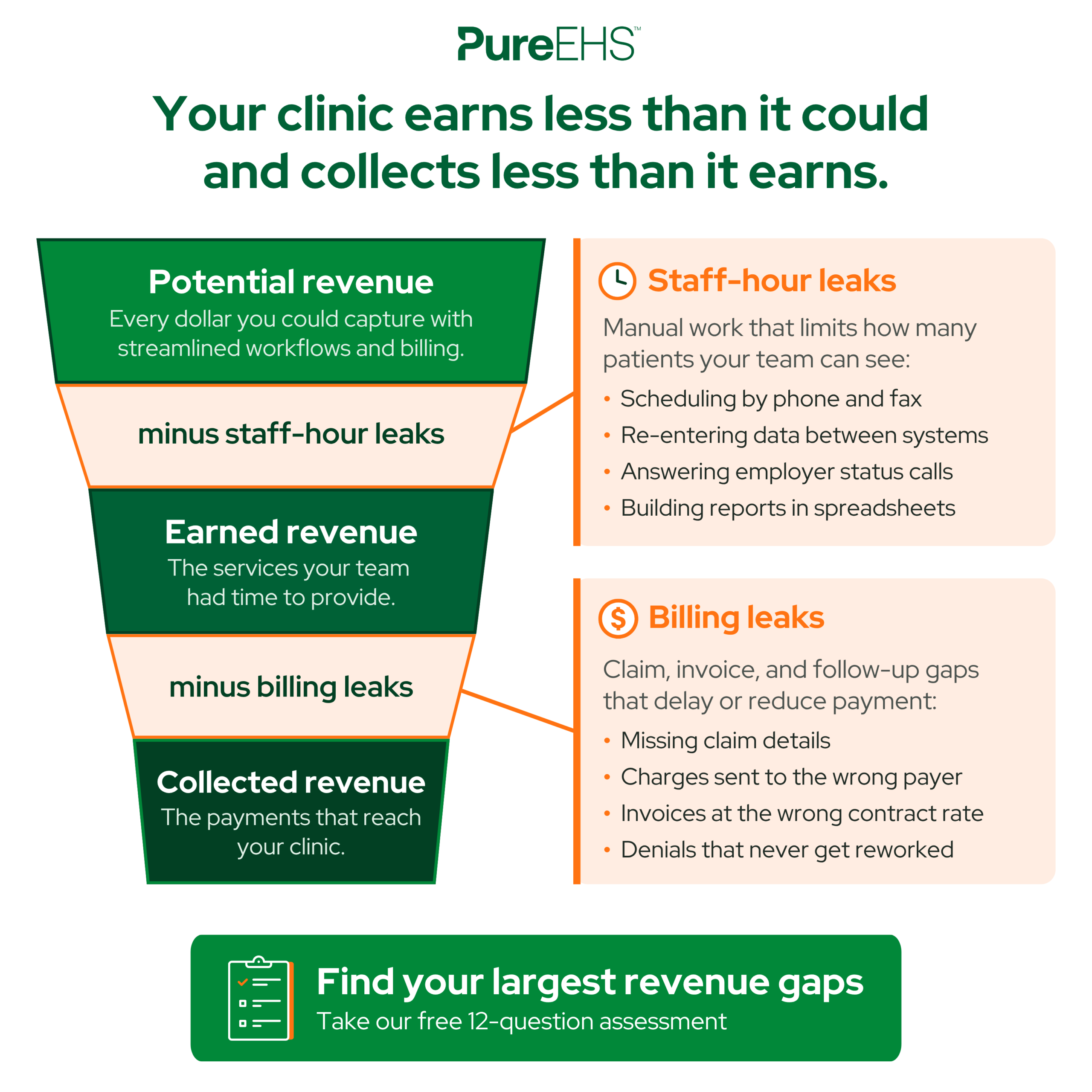
Staff-hour leaks come from manual work your system should handle. Every hour staff spend scheduling by phone, re-entering data between systems, or answering employer status calls is an hour they can’t spend with patients. That limits how many patients you can see, so you earn less than you could otherwise.
Billing leaks come from gaps in claims, invoices, and follow-up. Missing claim details, charges sent to the wrong payer, invoices at the wrong contract rate, and denials that never get reworked all delay or reduce payment. So you collect less than you earn.
The two feed each other. When staff are stretched thin by manual work, billing details are easier to miss. And every denied claim or disputed invoice adds more manual work to your team’s day.
Most workers’ comp billing problems start well before an invoice goes out, at steps that don’t look like billing at all. These are the six spots where we see revenue leaks happen most often.
1. Scheduling requests that leave out the details
Employers send visit requests by phone, email, or fax. When a request doesn’t spell out which services the employer authorized, staff have to guess or call back.
If staff perform a service the employer didn’t authorize, the employer may refuse to pay for it. If they miss one the employer did request, the worker has to come back for a second visit.
2. Check-in without claim details
Patient check-in at the front desk is often the first chance to capture or confirm the claim number, carrier, adjuster, and date of injury. If any of those details are missing, the claim gets rejected or held until someone takes the time to track them down.
Check-in is also the best time to assign each service to the right payer. Sorting that out after the visit takes far longer.
3. Visit notes that don’t support the claim
Primary care templates don’t usually have the fields to match the needs of an occupational health record, like work status and restrictions. Providers end up writing around the template, and coding errors are easier to miss. Every error, even a small one, is another reason why a carrier could deny or short-pay a claim.
For example, if a note for a back injury doesn’t describe how the accident happened on the job, the carrier has no record that the injury is work-related, and the claim can stall until someone sends further details.
4. Manual follow-up with employers and adjusters
An employer reviewing an invoice wants to know which services were billed and when the worker can return, without seeing protected clinical details. An adjuster will need the visit report before approving the claim.
When there’s no system for sharing this information and sending payment reminders automatically, staff have to follow up by phone or fax, often multiple times before an invoice gets paid.
5. Invoices that don’t match the contract
Each employer account typically has its own rates, its own panel of services, and its own invoice cycle. A charge billed at the wrong rate or sent on the wrong cycle can lead to a dispute or a short payment.
6. Reporting that can’t show revenue by employer
Without revenue and balances broken out by employer account, it’s hard to tell which accounts are profitable and which are behind on payment. That makes contract renewals harder to negotiate. It also means an employer that pays slowly can run up a large overdue balance before anyone notices.
Most occupational health teams know their workflows could be streamlined. After all, they feel the friction every day. But if you can’t put a dollar figure on what the inefficiencies are costing you, it’s hard to know where to make a change, and harder still to justify changes to leadership.
These three questions are an important starting point:
Fixing workers’ comp billing usually means fixing the steps that feed it. Look for a system that:
PureSYSTOC is the EMR and practice management platform built for occupational health. It automates workers’ comp and employer split-billing, which reduces claim denials and speeds reimbursement.
If you want to better understand where you’re missing out on revenue, and how a system like PureSYSTOC can help plug the leaks, our free self-assessment helps you quickly grade yourself on billing, employer accounts, documentation, and growth. Download the occupational health revenue assessment.
Explore more from PureEHS on managing workforce health, safety, and compliance.




Job title
Bio text