
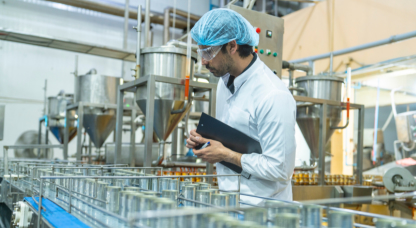
Food and beverage manufacturing is one of the most complex environments in which to manage employee health and safety, and one of the most underestimated.
From the outside, the hazards might seem straightforward compared to construction or heavy industry. But the reality inside a food or beverage facility is a layered combination of risks that’s genuinely unique: chemical exposures that aren’t always visible, ergonomic demands that build over years, machinery hazards in close proximity to workers moving at production pace, and strict regulatory requirements that span both food safety and occupational health.
Getting it wrong is expensive, and few facilities have compliance software built for this level of complexity in food and beverage manufacturing.
Food and beverage facilities deal with hazards that require a set of several separate management strategies.
Chemical exposure is a persistent concern. Ammonia refrigeration systems, industrial cleaning agents, and production-related substances like flour dust create real respiratory risk. Occupational asthma is a documented issue in the industry, particularly in baking and grain processing environments. Monitoring exposure, tracking which workers are in which zones, and keeping medical surveillance current for at-risk employees is required under OSHA’s exposure standards.
Ergonomic injury is the other major driver of workers’ comp costs. Repetitive motion on the line, awkward lifting, and sustained standing on hard surfaces add up over time. In 2024, food manufacturing’s total recordable case rate was 3.3 per 100 full-time workers, compared to 2.7 for manufacturing overall and 2.3 for private industry overall. A significant portion of those injuries are the kind that build gradually, meaning they’re preventable with the right visibility and early intervention.
Add in machinery hazards, temperature extremes, slippery surfaces, and the pace demands of production environments, and you have a work environment that needs much more than a basic incident log.
Food and beverage manufacturers operate under a dual compliance burden that most other industries don’t face. OSHA governs the safety side, but facilities also operate under FDA oversight. Many are also subject to FSMA requirements, creating a compliance environment where safety, quality, and regulatory documentation all have to function together.
OSHA designates food manufacturing as a high-hazard industry and requires electronic submission of injury and illness data for facilities above a certain size. That means your OSHA 300 records get filed directly with the federal government. Incomplete or inaccurate reporting carries the same penalty structure as any other OSHA violation. This is precisely the gap that food and beverage manufacturing compliance software is designed to close.
Managing EHS effectively in a food or beverage facility means tracking at the worker level. Which workers have completed required safety training for the equipment they operate? Who is in a chemical exposure zone that requires periodic medical surveillance? Which employees are in a return-to-work program following an ergonomic injury, and what job assignments are appropriate for them right now?
Those are worker-specific questions that require worker-specific records. A system that tracks incidents by location or event type can’t answer any of that. What it takes is a system built around the individual employee, connecting training, exposure history, surveillance results, and incident data in one place, which is exactly what PureOHS is built to do.
None of this works without training that actually matches these hazards. A worker running production-line machinery needs to understand the guarding on that specific equipment. A worker in an ammonia refrigeration zone needs to understand what that exposure actually requires. PureSafety is OSHA-authorized to create and sell that kind of training content, produced in-house by EHS professionals, so when a regulator or an attorney asks whether the training holds up, the answer is defensible.
In an industry where margins are thin and regulatory exposure is real, that’s what good food and beverage manufacturing compliance software delivers: a real competitive advantage.
See how PureEHS and PureSafety help food and beverage manufacturers track worker health, manage exposures, and deliver OSHA-authorized training in one connected system. Schedule a demo here.
Explore more from PureEHS on managing workforce health, safety, and compliance.




Job title
Bio text